
2K Games Claims 20% Borderlands 4 Performance and Stability Improvements Since Launch

Source: Techpowerup.com
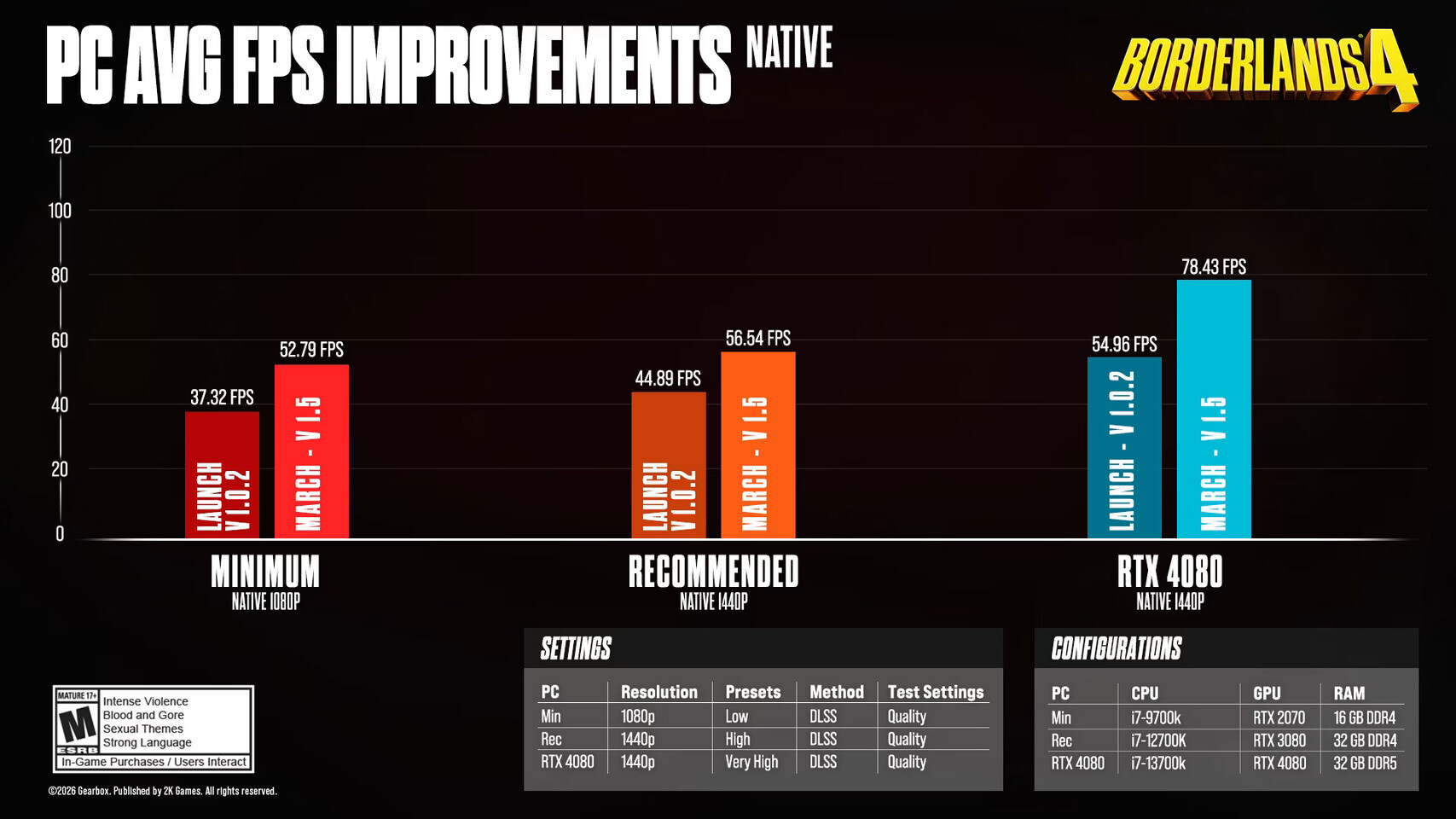
It’s no secret that Borderlands 4 launched with some serious performance issues, but 2K and Gearbox have long promised performance updates and fixes to improve stability and the overall gaming experience in the latest installment in the looter-shooter franchise. In a new update, 2K Games has walked through a number of changes that have been implemented and shown off some of the performance improvements that have been made in Borderlands 4 since the game’s launch. Gearbox and 2K tested the game’s v 1.5 update compared to the v 1.0.2 launch version across a number of in-game quality settings and with hardware configurations representing the minimum and recommended specs, as well as a typical high-end gaming rig, and found significant improvements in both average, 1% low, and 0.1% low FPS. The blog post detailing the testing and results claims around 20% performance improvement when comparing the launch version of Borderlands 4 to the March update, but things become more interesting when you look at how performance changed depending on the hardware and resolution.
The biggest changes noted in the test results were seen in the native resolution with no DLSS, with the NVIDIA GeForce RTX 2070 and Intel Core i7-9700K gaining around 43% FPS at 1080p Low, while the RTX 3080 and i7-12700K gained 26% at 1440p native and high graphics presets. Lastly, the NVIDIA RTX 4080 paired with an Intel Core i7-13700K went from 54.96 FPS to 78.43 FPS at 1440p native with very high graphics settings. The performance improvements with DLSS upscaling were less impressive, at between 17 and 35%, although that’s still a notable improvement, especially on the low-end, where frame rates jump from 53 to 67 FPS. 1% and 0.1% lows are up across the board, with some tests seeing 0.1% lows get nearly a 100% improvement, which will make the game feel significantly smoother. The Borderlands development team attributes the performance uplift to general efficiency improvements as well as refinements to the Shader PSO process (Pipeline State Objects). The developers also worked on reducing polygon counts for effects and optimizing features like effects, physics, cloth simulations, and Unreal Engine 5’s Virtual Shadow Maps, all of which helped reduce CPU and GPU usage during gameplay.

